

Sliding vs swing driveway gates is one of the first decisions in any gate project, and the right answer depends more on your driveway than on style. The slope, the space beside and behind the opening, how often the gate runs and whether you want automation all point you toward a sliding gate or a swing gate.
This guide compares both options for Vancouver and Lower Mainland properties, so you can choose with confidence before you ask for quotes.

Quick Answer: Which Gate Should You Choose?
Choose a swing gate if your driveway is level or slopes away from the gate, you have clear space for the gate to open, and you want a classic look at a lower starting cost.
Choose a sliding gate if your driveway slopes up behind the entrance, space behind the gate is tight, you park close to it, or you want an automatic gate that’s practical for daily use and windy sites.
Sliding vs Swing Driveway Gates Compared
| Factor | Swing gate | Sliding gate |
|---|---|---|
| Space needed | Clear arc behind (or in front of) the opening | Straight run of space beside the opening |
| Sloped driveway | Difficult if the driveway rises behind the gate | Usually works well |
| Wind | Large leaves act like sails in strong wind | Less affected by wind |
| Wide openings | Often split into a double gate | Single leaf can cover wide openings |
| Automation | Arm or underground operators | Rack-and-pinion operator beside the gate |
| Starting cost | Generally lower for a basic gate | Generally higher (track or cantilever hardware, foundations) |
| Look | Traditional, grand entrance | Clean, modern |
| Maintenance | Hinges and operator arms | Track or rollers kept clear of debris |
7 Factors That Decide Between a Sliding Gate and a Swing Gate
1. Driveway Slope
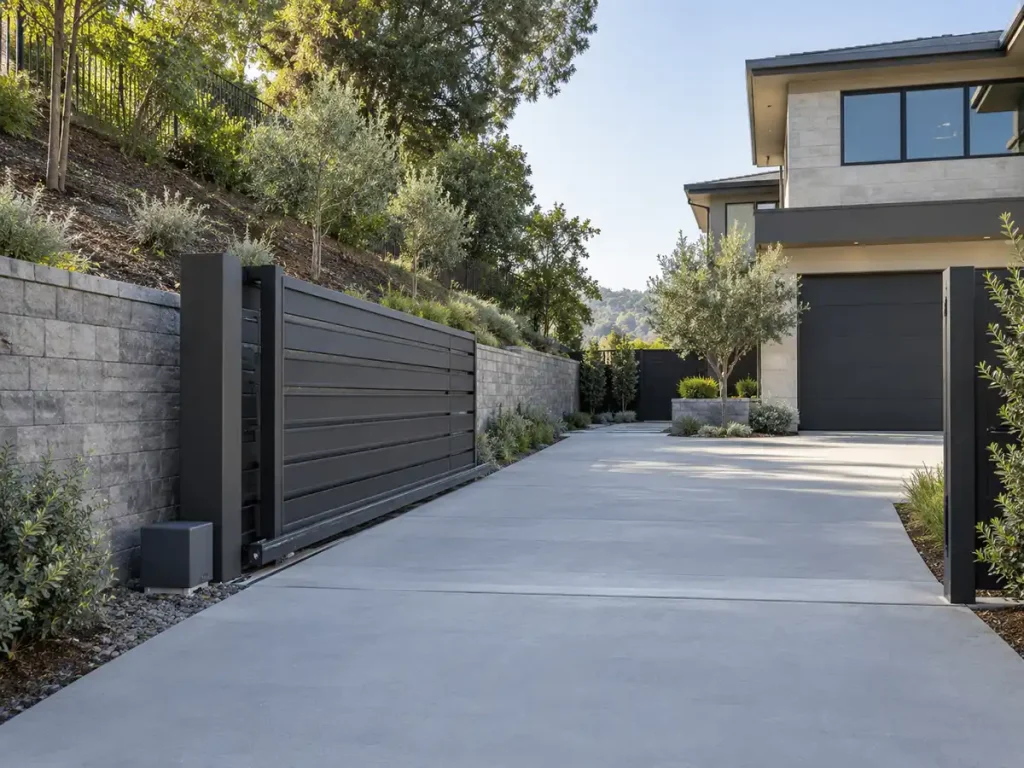
This is the deciding factor on many North Shore and hillside lots. A swing gate opening inward over a driveway that rises behind it will hit the ground part-way through its swing. You can raise the gate, use a rising hinge or open it outward, but each has trade-offs. A sliding gate moves sideways across the opening, so the rise behind it doesn’t matter. On uneven or gravel driveways, a cantilever sliding gate avoids a ground track altogether; see Cantilever Gates for Sloped or Uneven Driveways.
2. Space Beside and Behind the Gate
Measure both. A swing gate needs a clear arc roughly equal to the width of each leaf, with no parked cars, planters or steps in the way. A sliding gate needs a straight run beside the opening at least as long as the gate itself, and longer for a cantilever gate, which has a counterbalance tail. On narrow city lots, one of these is often ruled out immediately.
3. How Close You Park
If cars park right behind the gate, an inward swing gate can’t open. A sliding gate stays in line with the fence, so it never sweeps into the driveway. For busy households with several vehicles, that alone can settle the choice.
4. Wind and Exposure
A solid privacy swing gate catches wind like a sail, which strains hinges and operators and can make the gate hard to control. A sliding gate runs in a guided track or on rollers, so it handles exposed, windy sites better, especially with solid infill.

5. Width of the Opening
Wide driveways often need a double swing gate, with two leaves meeting in the middle. A single sliding gate can cover the same opening in one panel, which means one operator and a cleaner look. Very wide commercial openings are almost always sliding or cantilever gates.
6. Automation and Daily Use
Both gates can be automated. Swing gates use arm operators mounted on the posts or underground operators hidden below the hinge. Sliding gates use a rack-and-pinion operator mounted on a pad beside the opening, which is simple, reliable and well suited to frequent use. Either way, include safety devices such as photo-eyes and a manual release, and plan for power at the gate. If you’re upgrading a manual gate, read our automatic gate retrofit guide, and browse gate hardware and accessories.
7. Style of the Property
A swing gate gives a traditional, grand entrance, and arched tops or decorative ironwork suit classic homes. A sliding gate with horizontal aluminum slats or solid panels suits modern architecture. Both can be made in steel or aluminum, in almost any colour and level of privacy. For ideas, see our decorative driveway gate projects.
Cost: Sliding Gate vs Swing Gate
For a simple manual gate, a swing gate usually costs less, because the hardware is just posts and hinges. Sliding gates need a track or cantilever rollers, a gate long enough to cover the opening plus overlap, and stronger foundations, so they typically start higher.
Once you add automation, the gap often narrows. On difficult sites, a sliding gate can even be the more economical option because it avoids regrading the driveway or using special hinges. For a full breakdown, see Metal Gate Cost in Vancouver.
Installation: What to Plan For
- Foundations: both gates need solid concrete footings for posts, and sliding gates may need a footing along the track or a large pad for cantilever rollers.
- Buried utilities: before digging, request a locate through BC 1 Call so footings stay clear of gas, power and water lines.
- Power: automatic gates need an electrical supply at the operator, and often low-voltage wiring for keypads, intercoms and sensors.
- Drainage: ground tracks should not sit in standing water, so plan how rain drains at the opening.
- Bylaws: most municipalities do not allow a gate to swing over a public sidewalk or street, and some have height limits for front-yard gates and fences.
What About Vancouver’s Rain?
Ground-track sliding gates need the track kept clear of leaves, gravel and standing water, so drainage at the opening matters. Swing gates need hinges and operators kept lubricated and adjusted to avoid sagging over time; see How to Prevent a Gate From Sagging. Whichever you choose, powder-coated aluminum or galvanized steel holds up best in our climate. More on that in Which Driveway Gates Are Better for Vancouver’s Climate.
Maintenance Checklist
Swing gates: check hinges and lubricate them a few times a year, keep the latch aligned, and adjust operator arms if the gate starts to drag.
Sliding gates: keep the track or rollers clear of debris, check the rack and pinion for wear, and make sure guide rollers at the top of the gate stay snug.
Both: test photo-eyes and safety edges regularly, and book a professional service if the gate becomes noisy, slow or misaligned.


Choosing a Material for Your Driveway Gate
Whether you pick a sliding gate or a swing gate, the material affects weight, maintenance and price.
- Aluminum: light, rust-free and low maintenance, which makes it ideal for long sliding gates and automatic operators. Horizontal slat designs are popular for modern homes.
- Steel: strong and secure, with a classic wrought-iron look. Galvanizing and powder coating protect it from Vancouver’s rain.
- Wood or composite infill: warm and private, usually on a steel or aluminum frame so the gate stays straight.
Lighter gates are easier on hinges, rollers and operators, so material choice also affects how long the hardware lasts.

Sliding vs Swing Gate FAQ
Which is more secure?
Both can be equally secure when built well and fitted with a good lock or operator. Sliding gates are harder to force open because they run in a guided track.
Can a swing gate open outward?
Sometimes, but not over a public sidewalk or street in most municipalities. Check local bylaws first.
Which lasts longer?
Lifespan depends more on materials, installation and maintenance than on the type. A well-built gate of either type can last for many years.
Can I add a pedestrian gate?
Yes. Many properties pair a sliding or swing driveway gate with a matching pedestrian gate so people don’t have to open the large gate.
Which is better for a sloped driveway?
In most cases a sliding gate, because it moves sideways and doesn’t need to clear the rising ground behind the entrance.
Get Help Choosing Your Driveway Gate
Since 2005, Cypress Railings & Gates has designed, fabricated and installed custom swing, sliding and cantilever gates from our North Vancouver shop. We’ll look at your slope, space and how you use the driveway, then recommend the gate that fits and give you a free written estimate. Financing is available through iFinance.
See our driveway gates or call (604) 260-0302.


