
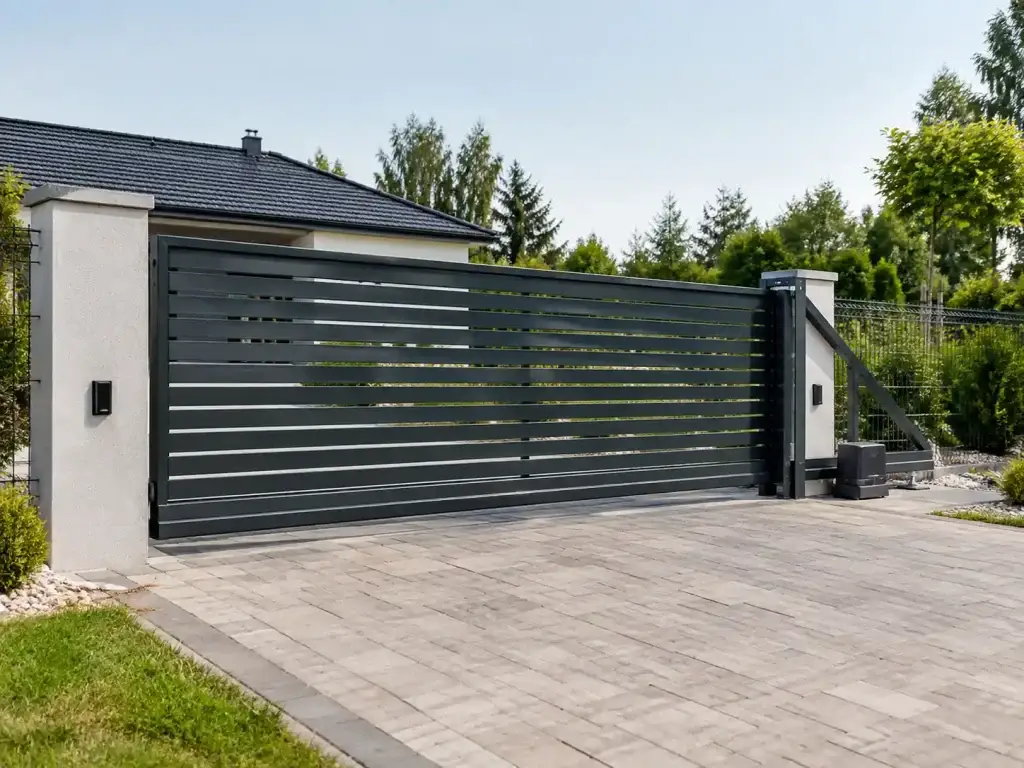

Yes, cantilever gates can be an excellent choice for sloped or uneven driveways because the gate does not need a ground track across the vehicle entrance.
Instead of rolling directly on the driveway surface, a cantilever gate is supported by rollers and a structural frame positioned beside the opening. This allows the gate to move across areas where pavement is uneven, gravel is present, drainage channels cross the entrance, or the driveway rises or falls away from the street.
However, not every slope presents the same conditions.
The direction of the slope, clearance beneath the gate, available side space, supporting foundations and the path the gate follows when opening all need to be assessed before choosing a system.
For homeowners comparing different driveway gate options, a cantilever system is often one of the first designs worth considering when the entrance is not level.
Are Cantilever Gates Good for Sloped Driveways?
In many cases, yes.
A traditional tracked sliding gate depends on wheels travelling along a ground-level track. If the driveway surface is uneven, damaged, gravel-covered or difficult to keep clear, that track can become more complicated to install and maintain.
A cantilever gate works differently. The gate is suspended from a roller system installed beside the entrance rather than travelling on wheels across the driveway itself.
This means irregularities in the active driveway surface do not directly determine the path of the gate.
Cantilever gates can therefore be particularly useful for:
- Driveways that slope upward from the street
- Uneven concrete or asphalt entrances
- Gravel driveways
- Entrances with drainage channels
- Properties where leaves and debris frequently collect
- Driveways where installing a continuous ground track would be difficult
- Residential, strata and commercial entrances with frequent vehicle traffic
The important question is not simply whether the driveway is sloped, but which direction it slopes and where the gate needs to travel.
The Direction of the Driveway Slope Matters
Not all sloped driveways affect a gate in the same way.
Before selecting a cantilever system, it helps to separate the slope into three common situations.
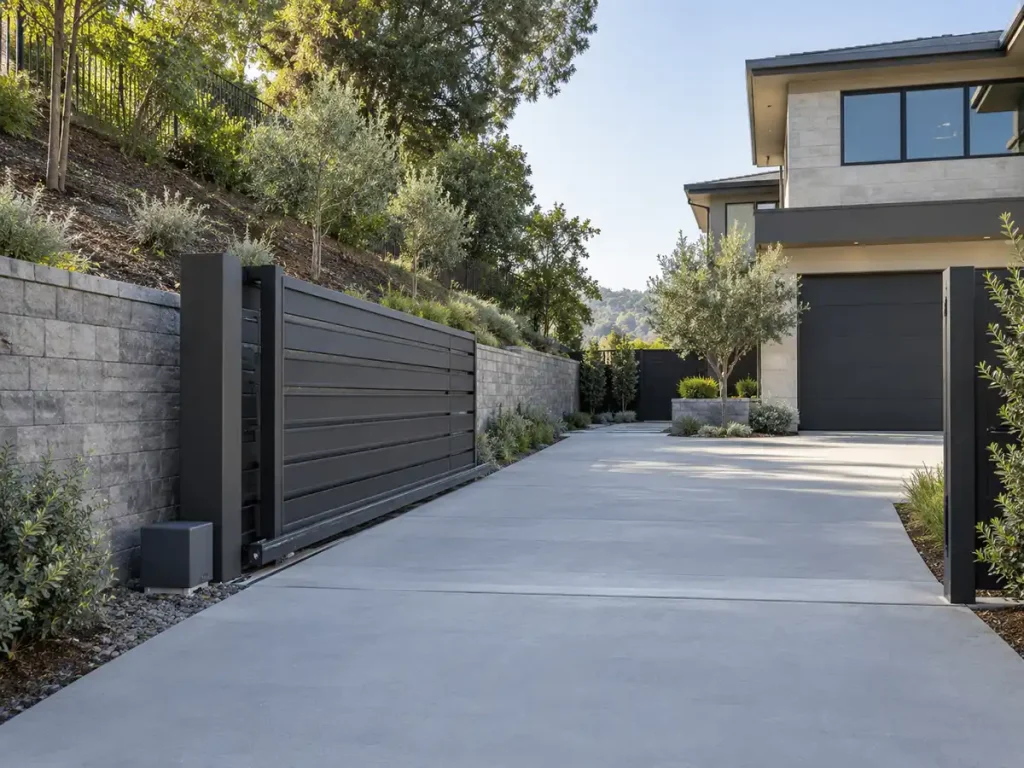
1. The Driveway Slopes Up or Down From the Street
This is common on hillside properties.
The driveway may rise toward the house or descend from the street while the gate travels horizontally from left to right across the entrance.
This is often a good application for a cantilever gate because the gate does not need to swing over the rising driveway surface.
A swing gate can encounter clearance problems when opening toward an uphill surface. A sliding cantilever gate avoids the swing arc entirely and moves sideways instead.
The gate still needs adequate clearance above the driveway, but the rising approach itself does not require a track to be installed across the entrance.
2. The Ground Slopes From One Side of the Entrance to the Other
A side-to-side slope requires more careful planning.
A cantilever gate normally travels along a controlled, straight path while the ground underneath may rise or fall.
If the difference in elevation is relatively small, the gate can often be positioned to maintain practical clearance.
If the cross-slope is significant, however, one end of the opening may have considerably more clearance beneath the gate than the other.
That can affect:
- Appearance
- Privacy
- Pet containment
- Security
- Clearance beneath the gate
- Alignment with adjacent fencing
The gate design may therefore need to account for the grade rather than simply installing a standard rectangular panel.
3. The Ground Beside the Driveway Slopes Where the Gate Must Open
This situation can be more challenging.
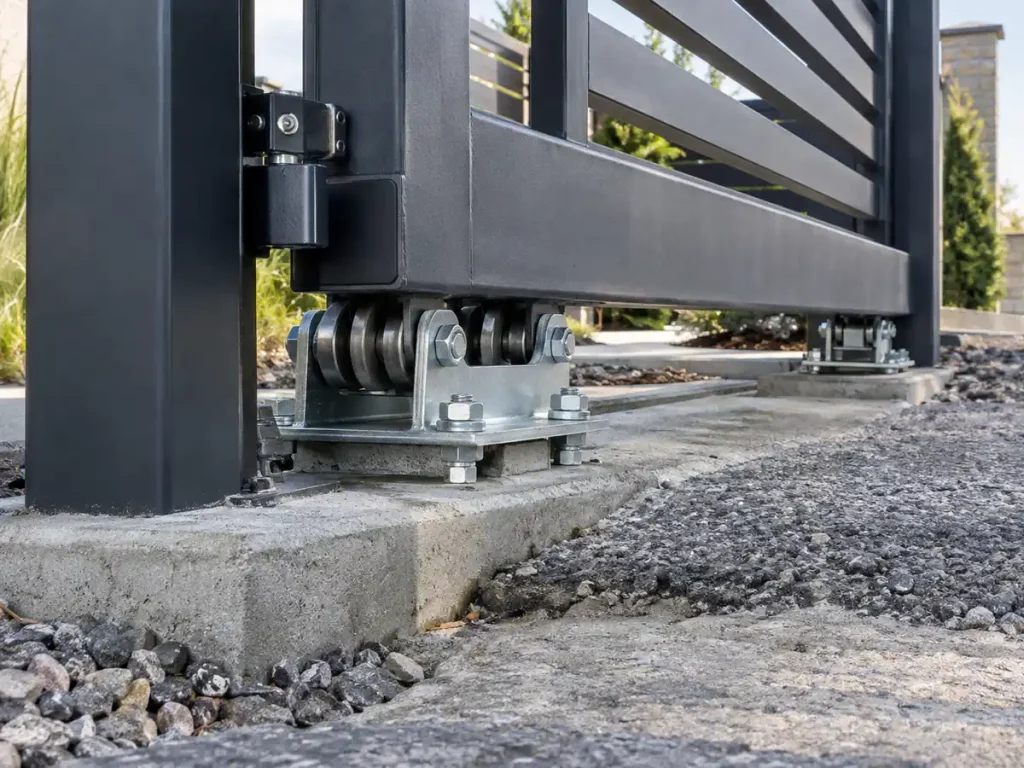
A cantilever gate needs sufficient space beside the opening for the gate panel and its extended structural section.
That side area also needs to accommodate the support posts, rollers and gate movement.
If the gate’s opening path itself rises or falls significantly, the system becomes more complex because the gate cannot simply follow an irregular ground surface like a vehicle.
A site assessment is especially important in this situation.
The driveway entrance may appear suitable for a cantilever gate while the storage area beside it creates the actual design limitation.
Why Cantilever Gates Work Well on Uneven Ground
The main advantage is simple: there is no ground track across the active driveway opening.
A ground-track sliding gate typically uses wheels that travel along a rail installed at or near the driveway surface.
For that system to operate reliably, the track needs suitable support and alignment.
A cantilever gate removes this track from the vehicle crossing.
This can provide several practical advantages on difficult sites.
No Track to Follow Uneven Pavement
Cracks, minor elevation changes and irregular pavement are less likely to interfere directly with gate movement because the gate is suspended above them.
Better for Gravel Entrances
Loose gravel can make a ground-level track more difficult to keep clean and stable.
A cantilever system keeps the operating mechanism away from the main vehicle surface.
Less Interference From Leaves and Debris
Leaves, stones, mud and other material can collect around driveway entrances.
Removing the ground track eliminates one location where this debris could interfere with the gate wheels.
Easier Integration With Some Drainage Layouts
North Vancouver and Greater Vancouver properties often need effective drainage because of frequent rainfall.
If a drainage channel, trench drain or changing surface level crosses the entrance, installing a continuous sliding-gate track can become more complicated.
A cantilever configuration may allow the driveway and drainage system to remain relatively unobstructed.
For more information about rain, moisture and local gate conditions, see our guide to choosing driveway gates for Vancouver’s climate.
How Much Ground Clearance Does a Cantilever Gate Need?
Ground clearance needs to be sufficient to prevent the gate from contacting the driveway as it moves.
There is no single clearance measurement that works for every property.
The required space depends on factors such as:
- Driveway slope
- Changes in elevation
- Gate length
- Gate frame design
- Surface condition
- Snow and debris exposure
- Required privacy
- Adjacent fencing
- Vehicle entrance layout
Too little clearance can cause the gate to contact a high point in the driveway.
Too much clearance may create an undesirable opening beneath the gate.
The correct approach is therefore to identify the highest points along the entrance and determine an appropriate gate position based on the complete site.
Does a Cantilever Gate Have to Be Level?
The gate and its supporting system need to follow the alignment established for the specific installation.
The important distinction is that the driveway surface underneath does not necessarily have to follow the same line.
This is one reason cantilever systems can work well over uneven ground.
The gate can travel along its designed path while the driveway beneath it changes slightly in elevation.
However, significant slope along the actual direction of gate travel requires more detailed design.
The supporting rollers, structural frame, posts and automation equipment all need to operate together without placing unnecessary resistance on the system.
How Much Side Space Is Required?
Cantilever gates require more side space than many conventional sliding gates.
The gate does not consist only of the section that blocks the driveway.
An additional structural section extends beyond the opening and helps support the gate through the roller system.
That means a property with a driveway wide enough for the gate may still lack enough room beside the entrance for the complete cantilever assembly.
Before installation, the side area should be checked for:
- Property boundaries
- Retaining walls
- Buildings
- Trees
- Landscaping
- Utility equipment
- Pedestrian gates
- Existing fences
- Changes in ground elevation
- Available foundation locations
This is particularly important on hillside properties, where retaining walls and elevation changes can limit usable space beside the entrance.
What About the Cantilever Gate Foundations?
Although the gate does not require a track across the driveway, it still requires substantial structural support on one side of the opening.
The roller assemblies and supporting posts carry the gate while it is suspended.
The foundation design therefore needs to account for the gate dimensions, weight, supporting structure and site conditions.
Poor ground conditions or unstable soil should be identified before installation.
A sloped driveway does not automatically prevent installation, but the area supporting the gate needs to be suitable for the structural system being used.
Before any footings are dug, request a utility locate through BC 1 Call so the foundations stay clear of buried gas, power and water lines.
Can an Automatic Cantilever Gate Work on an Uneven Driveway?
Yes. Cantilever gates can be automated for residential and commercial entrances.
The operator moves the gate along its supporting system rather than pulling it over the driveway surface.
Automatic systems can include:
- Remote controls
- Keypads
- Intercoms
- Telephone entry
- Vehicle detection
- Access-control systems
- Photo-eye sensors
- Safety edges
- Manual-release systems
- Backup power options
The operator should be selected according to factors such as gate size, weight and expected opening frequency.
You can explore automatic gate hardware and accessories used for sliding and cantilever systems.
Proper alignment is particularly important for an automatic gate. The motor should move a gate that is already mechanically balanced and operating smoothly rather than compensating for resistance caused by poor installation.
Cantilever Gate vs Swing Gate on a Sloped Driveway
A sloped driveway can create problems for a conventional swing gate.
Imagine a driveway that rises immediately behind the entrance.
As a swing gate opens inward, the bottom of the gate moves across increasingly higher ground. Without sufficient clearance or a specially designed configuration, the gate may eventually contact the driveway.
A cantilever gate avoids this issue because it moves sideways rather than sweeping across the driveway.
That makes sliding gate configurations particularly attractive when the driveway rises sharply after the property entrance.
However, a swing gate should not automatically be ruled out. The correct system depends on slope direction, available opening space, property layout and the surrounding structures.
Cantilever Gate vs Ground-Track Sliding Gate
Both systems move sideways, but the way they are supported is different.
| Feature | Cantilever Gate | Ground-Track Sliding Gate |
|---|---|---|
| Track across driveway | No | Yes |
| Uneven driveway | Often well suited | More dependent on surface |
| Gravel entrance | Often easier to accommodate | Track area requires consideration |
| Debris in driveway | Less direct effect on gate path | Track must remain clear |
| Side space | More required | Generally less |
| Structural support | Significant side support required | Gate supported partly by ground wheels |
| Automation | Available | Available |
| Sloped entrance | Often a strong option | Depends heavily on track conditions |
Neither system is automatically better for every property.
A relatively level entrance with a suitable surface may work very well with a ground-track system.
A driveway with changing elevations, gravel, drainage issues or difficult surface conditions may be a stronger candidate for a cantilever design.
What About Vancouver Rain, Snow and Debris?
Weather is another reason to evaluate the gate mechanism rather than choosing by appearance alone.
Vancouver and North Shore properties can experience prolonged rain, wet leaves, dirt and occasional snow or freezing conditions.
Any exterior gate needs appropriate materials, protective finishes, drainage and routine maintenance.
A cantilever gate has the advantage of removing the operating track from the driveway opening, but the rollers, posts, guides, motor, electrical components and safety equipment still need periodic inspection.
Good drainage around the supporting foundations is also important.
When Is a Cantilever Gate Not the Best Choice?
A cantilever gate may not be suitable when there is insufficient room beside the driveway for the full gate and supporting section.
Other possible limitations include:
- Major obstacles beside the entrance
- Insufficient space for foundations
- Significant changes in grade along the gate’s opening path
- Property boundaries close to the entrance
- Retaining walls that restrict installation
- Site layouts where another gate system provides a simpler solution
This is why the entire operating area should be evaluated not just the width of the driveway.
What Should Be Checked Before Installation?
Before choosing a cantilever gate for a sloped or uneven driveway, the site assessment should consider:
- The width of the vehicle entrance
- The direction and severity of the slope
- High and low points across the driveway
- Available side space
- Ground conditions around the support posts
- Drainage around the entrance
- Retaining walls and landscaping
- Adjacent fencing
- Required ground clearance
- Gate material and weight
- Manual or automatic operation
- Electrical access for automation
- Vehicle and pedestrian traffic
- Privacy and security requirements
These factors determine whether a cantilever gate is practical and how the system should be fabricated.
Are Cantilever Gates Suitable for Residential Driveways?
Yes. They can be particularly useful for hillside homes where a swing gate would interfere with an uphill driveway.
The gate can also be customized to complement the architecture of the property using horizontal aluminum slats, privacy panels, open metal pickets or other custom designs.
Homeowners comparing visual styles can browse our decorative driveway gate projects for examples of custom entrance designs.
Are Cantilever Gates Suitable for Commercial Properties?
Yes.
Commercial entrances often benefit from the clear vehicle path provided by a cantilever system.
Applications may include:
- Parking entrances
- Warehouses
- Strata properties
- Storage yards
- Industrial facilities
- Commercial parking areas
- Controlled-access entrances
Because commercial gates may operate much more frequently than residential gates, the structure, rollers and automation system need to be selected for the expected duty cycle and gate dimensions.
Frequently Asked Questions
Can you install a cantilever gate on an uphill driveway?
Often, yes. If the driveway rises inward while the gate moves sideways across the entrance, a cantilever system can avoid many of the clearance problems associated with an inward-opening swing gate.
Can a cantilever gate work over gravel?
A cantilever system can be well suited to gravel entrances because it does not require wheels to travel on a track across the gravel surface. The supporting area and foundations still need to be properly prepared.
Does a cantilever gate touch the ground?
The active gate panel is supported by the cantilever roller system rather than wheels travelling across the driveway.
Can a cantilever gate cross uneven concrete?
In many cases, yes. Because there is no ground track across the entrance, minor variations in the concrete surface are less likely to interfere directly with gate movement. Adequate clearance still needs to be maintained.
Can a cantilever gate follow a steep slope?
This depends on the direction of the slope. A driveway that slopes beneath the gate is different from a gate that would need to travel uphill or downhill as it opens. Significant elevation change along the gate’s travel path requires a site-specific assessment.
Can cantilever gates be automatic?
Yes. Cantilever systems can be combined with automatic operators, access-control equipment and safety devices.
Cantilever Gates for Sloped Driveways in Vancouver
A sloped or uneven driveway does not mean you have to give up on an automatic driveway gate.
In many properties, a cantilever system provides a practical solution because the gate moves above the entrance rather than depending on a track installed across the driveway.
The best results come from designing the gate around the actual property including the direction of the slope, highest and lowest driveway points, available side space, drainage, structural support and automation requirements.
Cypress Railings & Gates designs, fabricates and installs custom cantilever and sliding gate systems for residential and commercial properties throughout Vancouver, North Vancouver, West Vancouver and surrounding Lower Mainland communities.
If you have a sloped, gravel or uneven driveway, contact Cypress Railings & Gates and send photos and approximate measurements of your entrance. Our team can review the site conditions and help determine which gate configuration is appropriate for your property.


